SPMD OFF-LABEL
The hidden affordances of ordinary things — and the latent capacity in the systems, teams, and people you thought you'd already figured out how to use.
What "Off-Label" Means Here
There's a binder clip on my desk that has never once held a stack of paper. It anchors a charging cable. Some days it's a phone stand. It has been a chip clip, a bookmark, and the only thing between me and a sunrise leaking through a hotel curtain. Same clip. I never modified it. I just stopped seeing it as the thing it was sold to be.
Off-Label is a recurring column about doing that on purpose — to objects, and then to everything harder than objects.
The name is borrowed from medicine. Off-label prescribing means using an approved drug for a purpose it was never formally approved for — deliberately, carefully, because a physician looked past the label on the box and saw a second use hiding in the pharmacology. It's not misuse. It's a trained eye refusing to let the label define the limits of the thing.
This column points that same eye at the rest of the world.
The Fence You Stopped Seeing
Psychologists have a name for why most people only ever see one use for a thing: functional fixedness. The classic demonstration is Karl Duncker's candle problem — hand someone a candle, a box of thumbtacks, and matches, and ask them to fix the candle to the wall so it burns without dripping. Most people fail, because they see the box as a container for tacks and never as a shelf. The label on the box became a fence around their imagination.
That's the whole mechanism, and it runs your life more than you'd like to admit. An object, a tool, a role, a person — each one arrives wearing a label, and the label quietly hardens into a boundary. You stop perceiving the thing itself. You perceive only the job it came with.
The binder clip binds. The end. Except it doesn't end there — you just stopped looking.
Affordances: What a Thing Actually Offers
The counter-concept comes from design and perceptual psychology: affordances. An affordance is a possibility for action that an object offers a user — not what it's for, but what it makes possible. A chair affords sitting; it also affords standing-on, door-blocking, and coat-hanging. Those extra affordances were always there. The designer never advertised them. Your fixedness edited them out.
The uses that amaze us — fifty of them for a single binder clip — aren't new features. They're latent affordances: capabilities that were present the whole time, waiting for someone willing to ignore the label long enough to notice.
So the move at the heart of this column is simple to state and hard to practice: ignore the label, find the second use.
Why It Doesn't Stop at Objects
Here's the part that makes Off-Label an SPMD column and not a life-hack feed.
Functional fixedness doesn't respect categories. The same blindness that hides forty-nine uses of a binder clip is hiding capacity everywhere you've already made up your mind. Every issue of Off-Label walks the same ladder, from the trivial to the consequential:
Object — the binder clip, the thing on the desk. The proof of concept. Fun, tactile, low stakes.
System — the process you built to solve one problem that has quietly been solving three others you never credited it for. The workflow whose second use is the real one.
Team — the duty section you've been reading as a scheduling grid that is, off-label, a leadership pipeline. The role nobody wrote correctly.
Self — the most fixed object in your life. The self-story that says I'm the person who does X is the label on the binder clip: accurate, useful, and quietly fencing off everything else you're capable of.
The object is always the hook. The person is always the payload.
How to Read This Section
Off-Label runs whenever I find one worth writing. Some issues are pure object play. Some climb straight to the top of the ladder. The binder clip is the recurring mascot — patient zero of latent capacity — and it'll show up whenever I need to prove the move again from scratch.
Every issue will branch off this page. If you only read one thing, read this one; it's the lens that makes the rest make sense.
The Binder Clip Holds More Than Paper
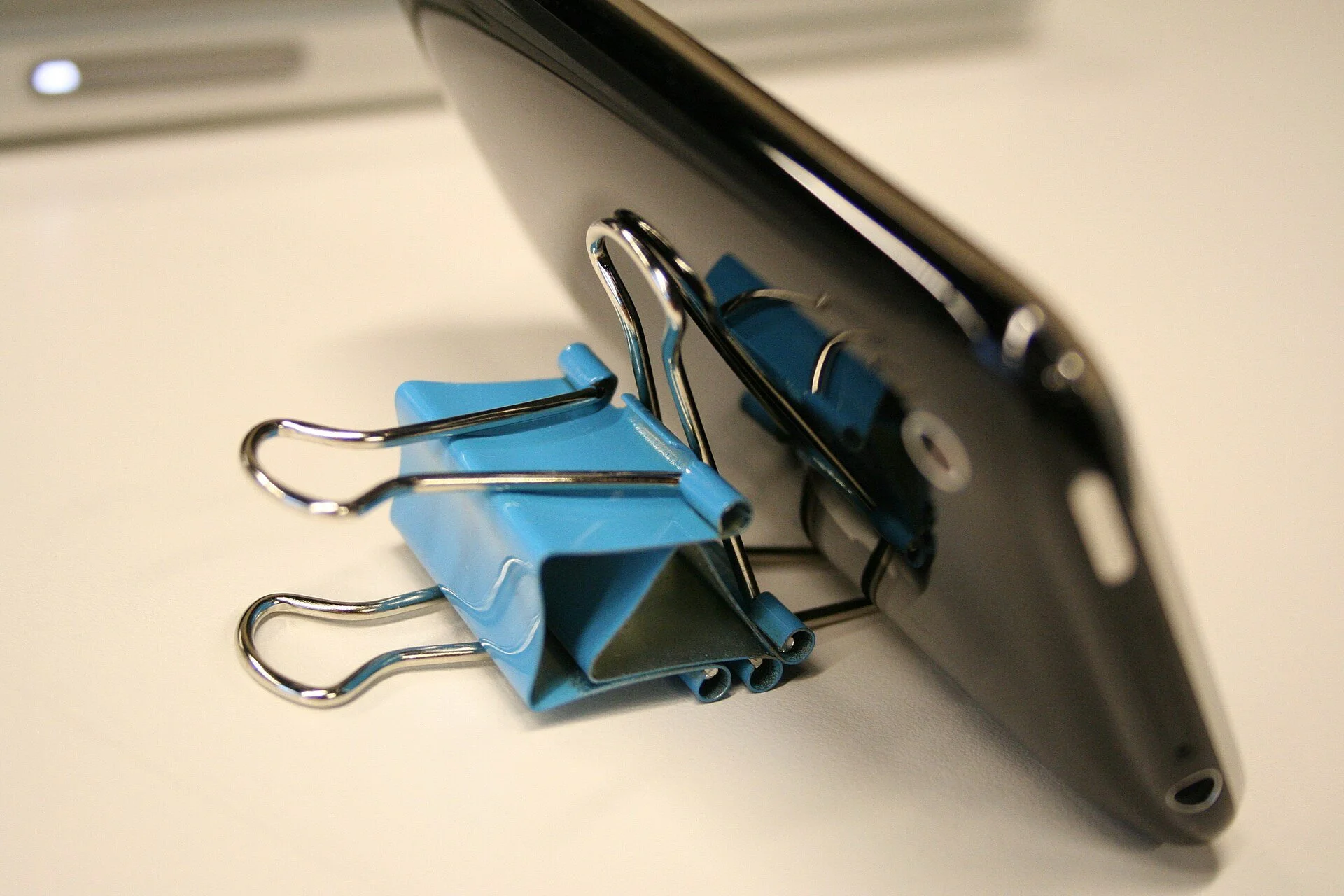
Binder clips used to hold up a cell phone. Image from wiki commons.
There's a binder clip on my desk aboard Boxer that has never once held a stack of paper.
It anchors my charging cable so it stops falling behind the desk. Some days it's a phone stand. It has been a chip clip, a bookmark, and — on one memorable port visit — the only thing standing between me and sunrise through a two-inch gap in a hotel curtain. Same clip. One stamped piece of spring steel. I never modified it. I just stopped seeing it as the thing it was sold to be.
Psychologists have a name for why most people never make that leap: functional fixedness. An object shows up in your life wearing a label, and the label quietly becomes a fence. You stop seeing the object and start seeing only the job it came with. The binder clip binds. The end.
Physicians have a term for jumping the fence on purpose: off-label. Using an approved thing for a purpose it was never approved for — deliberately, carefully, because you looked past the label and saw a second use hiding in plain sight. We do it all the time. This column is that same instinct pointed at everything outside the pharmacy.
And the binder clip is patient zero. Once you quit seeing "paper," here's a partial inventory of what one clip actually affords:
- Cable anchor — thread the charger through the wire handle at your desk edge; it never slips away again
- Phone stand — bend the handles, or interlock two, for a hands-free angle
- Chip / coffee / freezer-bag clip — a tighter grip than anything sold as a chip clip
- Pot-rim thermometer holder — clamp a candy or meat thermometer so it never touches the bottom
- Toothpaste squeezer — mini clip at the base of the tube, slide it up as it empties
- Razor guard — cap the blade in your dopp kit so it stops shredding everything else
- Hotel-curtain gap closer — the traveler's move; clip the light leak shut and sleep
- Money clip — strip the handles and you've got a minimalist wallet
- Keychain, bookmark, ID-badge clip — three "official" products replaced by one
- Keyboard feet — bend the rods to prop up the typing angle
- Gallery line — run a string, clip up rotating photos or a kid's art, swap freely
- Grip trainer — work up through clip sizes; the guitarists swear by it
I could keep going — the full catalog runs past fifty — but the length isn't the point. Any listicle can pad. The point is the move: ignore the label, find the second use.
Because here's the part that actually matters, and the reason this isn't a hack list. Functional fixedness doesn't stop at objects.
It's the process you built to solve one problem that has quietly been solving three others you never credited it for. It's the duty section you've been treating as a scheduling grid that is, if you look off-label, a leadership pipeline. And most of all, it's the bored nineteen-year-old whose real capability — the one that changes your whole department — is nowhere in his job description, because nobody bothered to read him past the label he arrived wearing.
I've been running that experiment all summer. My newest corpsmen showed up looking like single-purpose tools: do the next thing the phone tells you to do, and nothing else. Reorganizing the department has really been an exercise in reading each of them off-label — finding the second use nobody, including them, had noticed yet. Saban's whole doctrine of discipline to a process is, underneath the intensity, a flat refusal to accept the label a kid walks in with. You hold the process; the latent capacity surfaces on its own schedule.
And the most fixed object in your life is usually you. The self-story that says I'm the guy who does X is exactly the label on the binder clip — accurate, useful, and quietly fencing off every other thing you can do.
Off-Label will run whenever I find one. Sometimes it'll be a binder clip. Sometimes it'll be a system, a team, or a person. The move never changes: ignore the label, find the second use.
SPMD Off-Label — a SustainablePerformanceMD field column.