The SPMD After Action No. 2
Welcome.
The plan was to write this every Sunday. No good plan survives contact with reality. There was really only one reason I skipped last week, but I will say there were two. The first:
Something happened. Something good.
Something happened. Something good.
I follow Michael Yoo, MD FACP, and you should too, he writes honestly about what is broken in healthcare, including what he is living through right now trying to get his own mother the chemotherapy she needs. I commented on one of his posts, and Kim Joy Lind, PT challenged me to turn that comment into a full post of my own.
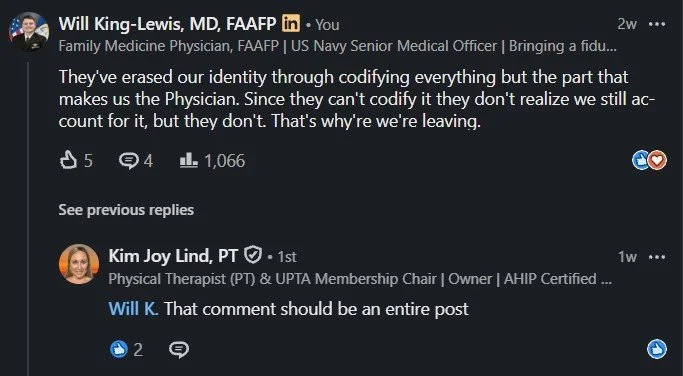
One of the best challenges I have ever accepted
I have never been so glad to accept a challenge. The post I made to meet Kim's challenge hit a nerve. Apparently what physicians experience, and what the System refuses to account for, is something a lot of us are carrying, not just me.
So I wrote a second piece. That one landed too, this time on trust, on being expected to do more with less and being trusted with less to do it.
A few days ago I decided, not just because three is my favorite number, that the series needed a third post, for my own closure and, I hoped, everyone else's. Turns out it was mostly mine.
Three commenters, all of whom already follow me, used some form of the word resonate on that first post. I had called resonate a stolen AI word on a post earlier that week. I now have a new position: We are taking it back! We will take back all the words the AIs have taken from us, one overused word at a time, reclaimed from every post-AI LinkedIn caption ever written. You are welcome, and can thank me later.
The second reason is that I do not want to write this every Sunday. If this grows, and thousands of you want to know my thoughts and ramblings, or pay for such things, then sure, I will write it all the time. Until then, if it is not a holiday Sunday and it is 14 days from the last one, one of these may show up.
This Week
This weekend I rebuilt a good portion of the SPMD Leak Assessment. It is worth explaining, because it is the whole reason a physician builds one of these.
Two people can describe the exact same symptom. "I know precisely what I should do, and I am not doing it." Most of the industry hears that sentence and reaches for the same motivational advice for both. They do not have the same problem.
One of them has Resistance. The will is intact. When the hard task comes up, they slide off it into something easier and more comfortable, and the thing that needs to happen is to Subtract whatever is pulling them away. The other has Nerve Failure. There is no easier task they run to. They simply freeze at the moment of starting, and the thing that needs to happen is to Execute one small action to break the seal. Same sentence out of two mouths. Opposite treatments. Hand a Resistance the Nerve Failure fix and you load more onto someone already overloaded. Hand a Nerve Failure the Resistance fix and you strip away structure they needed.
So this week the Assessment learned to tell them apart. When it detects that pattern, it now asks a single decisive question, and it routes on one thing: when you avoid the task, do you replace it with another activity, or do you just stall out. Substitution points one way. The freeze points the other. It is a small piece of logic. It is also the difference between a prescription that helps and one that quietly makes things worse.
If the Deckplate story below feels like a rhyme, that is not an accident. Two things that look identical on the surface, different causes underneath, and the entire job is refusing to treat them as the same.
I also spent a good part of the week feeding the site, which is why the Field Notes list further down is long. And a small aesthetic note: I rebuilt the SPMD monogram, so the S and P finally read as one system instead of two. Overdue, and satisfying.

I am obviously not a graphic artist
From the Deckplate This Week
We found a real problem this week, and I am glad we found it before it cost us a fifth time.
Some of my Sailors believed that identifying a discrepancy during inspection prep meant the discrepancy was handled.
Most of us know that it does not. Identifying it is step one. Step two is tasking it to a specific person. Step three is following up on that tasking. Step four is verifying the fix is actually complete and actually satisfies the inspection item. Then it loops. Re-run the full baseline inspection. Re-task anything still open or newly found. Verify those. Run the baseline again. You are ready for inspection only when a clean baseline comes back with nothing left. Identify is the first move, not the finish line.
We only caught this because my Senior Chief dug in after he heard our Sailor use the word "done." Something is done that wont be formally inspected for months does not make sense. Seniors response was close to, "done? This is not for months. What does 'done' mean?" You can envision the conversation that followed
Here is what I want other leaders to sit with. My first instinct was to call this ineptitude. I was wrong, and here is why. The same corpsmen run a nearly identical process, presurvey, rectify, resurvey, ready, every single week for uniform inspections, without a single reminder. They know the dance. They just did not recognize it as the same dance wearing a different name. That is not incompetence. It is a failure to bridge a procedure they already own into a new context, and the fix is not more instruction on steps they already know. It is drawing the line between the two explicitly, out loud, once.
Damien Faughnan and the Standing Challenge
A few weeks ago Damien Faughnan, who has spent over twenty years coaching executives through their hardest transitions, published a long piece on the coaching industry's self-regulation problem. I commented, asking whether organizational buyers have actually gotten better at screening for depth, or whether the credential still does most of the work for them.
He responded this week and said that it is all over the map. He noted that some buyers are sophisticated, but they are rare. So I asked a follow-up question: does coaching need something closer to medicine's licensing and board review?
He did not hedge. Licensing "would certainly help," he replied, and he called the ICF, the field's main credentialing body, suboptimal to say the least. Then he sketched what a real licensing body would require: an advanced degree, supervised practice hours, and passing exams. That is a practitioner with over twenty years in the field independently describing the same structure medicine already has.
His most interesting point in his reply was that he does not think it will happen! He thinks the professional services firms entering coaching will have no incentive to invite regulation. His read is that they will face their own reckoning eventually, on their own timeline, not a board's.
Sit with that for a moment...The person best positioned to defend voluntary self-regulation just told me the voluntary body doesn't work, that formal licensing would help, but that the industry will not adopt it on its own. That is not my argument being imposed from outside medicine. That is the coaching profession's own veteran describing the gap from the inside.
What I Read and Am Reading
This week I finished Faster: A System for Finishing What Matters. Decent book, a good little framework for fixing task completion and a new process to run. But it does not get into performance improvement, and it only briefly touches the underlying reasons you needed a new process to begin with. I am now three-quarters through The Field Guide to Understanding Human Error, and exactly five-twelfths through The Daily Surgeon.
Deployment completed book list is now: Dungeon Crawler Carl books 4, 5, 6, 7, The Personal MBA, The Lion Tracker's Guide to Life, Focus on the Process: The Simple "Secret" to Achieving Your Goals, Split Second: Stop Stalling, Start Doing, The Wisdom of the Bullfrog, Self Discipline: The Complete Mindset Guide to Hacking and Stacking Habits of Mental Toughness, The Checklist Manifesto, Faster: A System for Finishing What Matters.
Field Notes Published Over the Last Two Weeks
Fourteen published. Most are for the search and AI engines, and live only here on the site, not on my LinkedIn. We are establishing a clinical authority brand, and that means posting almost daily on the site so the engines recognize it.
They Codified Everything Except the Part That Makes Us PhysiciansThere is no CPT code for the moment a patient grabs your hand and says they are scared. A physician on why the unbillable parts of medicine are the parts keeping people alive, and why we are leaving.
They Stopped Trusting Us to Do It: The Second Reason Physicians Are LeavingThe shortage is not a mystery. It is a mechanism. A physician explains the trust-to-expectation ratio, the prior authorization apparatus, and why efficiency became a trap.
What a Physician Exodus Will CostPhysicians are leaving medicine because expectations do not match reality and responsibility does not match capability. This is the third and final piece in a series on why, and what it costs everyone.
Precision Coaching Is Not More Coaching. It Is Targeted Coaching.Precision coaching for leaders is not a more intensive version of standard coaching. It is coaching calibrated to a specific individual's performance architecture after a clinical diagnostic.
An Executive Performance Program with Physician OversightMost executive performance programs have no physician involved. Here is what physician oversight adds to a performance program and why it changes the clinical outcome.
Ready to Work with a Performance Coach? This is Where You StartIf you're ready to work with a performance coach but not sure where to start, identifying performance leaks is the first step when the process is physician-led and evidence-based and held to a fiduciary standard.
Ready to Improve Your Leadership Performance? Start With What's Limiting It.If you're ready to improve your leadership performance, the first question is not what to add. It is what is currently limiting the performance you already have.
How to Fix Energy Crashes During the WorkdayEnergy crashes during the workday are not a caffeine problem. They are a physiological signal from a system running below its sustainable threshold.
Finally, Executive & Leadership Coaching with Real Medical Credibility and RigorLeadership Coaching with Medical Credibility and Rigor. Medical credibility in coaching is not a credential to display. It is a standard of practice that changes how recommendations are made, evaluated, and revised.
Why A Sustainable Performance Physician Holds Coaching to a Fiduciary Standard, and Not a Research StandardDemanding a perfect study for every coaching intervention sounds rigorous. It is not. A physician explains why best interest, not maximum evidence, is the real standard. and why he holds coaching to a fiduciary standard, not a publishable research or peer review standard.
The Clinical Threshold: When a Performance Problem Is Actually a Health ProblemPerformance and health are not separate conversations. The line between them moves, and most coaches are not trained to see it.
Spent: The Performance DRAINS That Makes Refills Longer and LongerSpent is the performance DRAINS that makes refills take longer and longer. The tank empties. You recover. It empties again faster. That is not tired. That is spent.
Nerve Failure: The Performance DRAIN That Won’t Let You Do When You Know Exactly What to DoNerve Failure Performance DRAINS is the Performance Leak that will not let you do when you know exactly what to do
Performance Coaching That Doesn't Push SupplementsMost performance coaching comes with something to sell you. A physician explains why the supplement on the back end is a conflict of interest, and what coaching held to a fiduciary standard looks like instead.
The Assessment
Free. Ten minutes. No supplement attached. SustainablePerformanceMD.com/assessment
Performance. Assessed.
Will King-Lewis MD FAAFP, Sustainable Performance Physician, Founder of Sustainable Performance MD
You can contact me at will@sustainableperformancemd.com
The SPMD After Action usually publishes every other Sunday.
This After Action was originally posted here on LinkedIn.